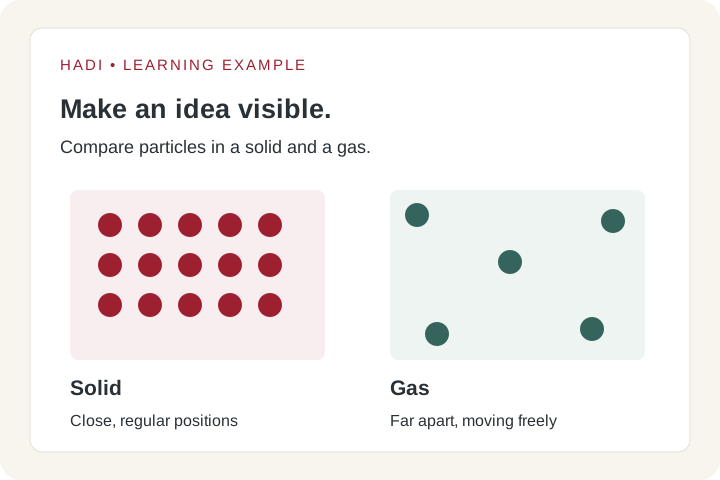
Interactive learning
Use diagrams to connect ideas: for example, compare the particle model of a solid with a gas.

Our approach
Interactive teaching and purposeful practice, with personalised support along the way.
Find the right starting point
Find your child’s starting point, identify gaps in understanding and discuss the support they need. The assessment helps guide a personalised learning plan.
Ask about arranging the free assessment when you enquire. Lesson fees and booking arrangements are agreed separately.
Ask about a free assessment
From understanding to exam practice
Preparation matters. Lessons connect clear understanding with the skills students need when faced with an exam question.
Exam-style questions · Past papers · Mark schemes
Explore the learning examplesInside the learning
A varied approach that gives students ways to explore, practise and check their understanding.
Use diagrams to connect ideas: for example, compare the particle model of a solid with a gas.
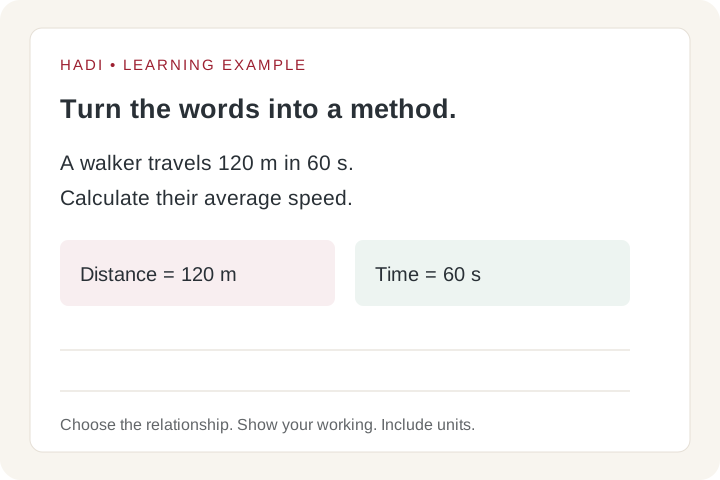
Identify the useful information in a question, choose a relationship and show the working.
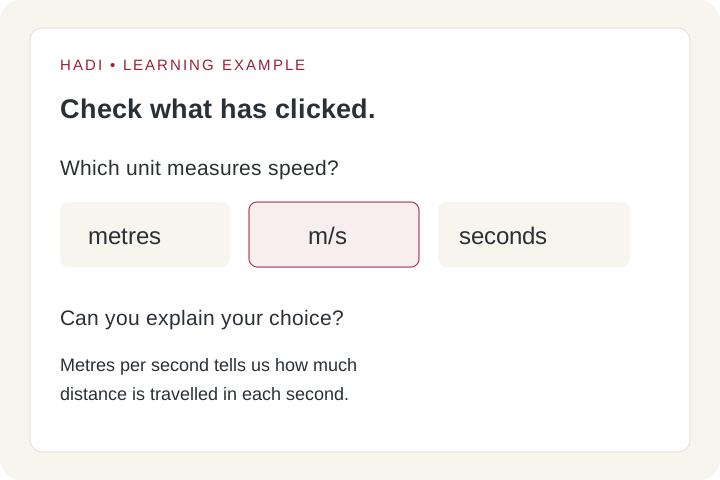
A quick units question can reveal whether the calculation makes sense, not just whether it is correct.
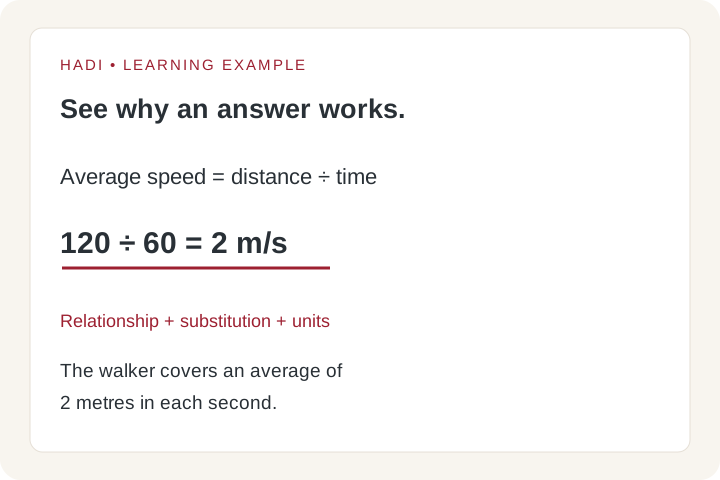
Review the relationship, substitution and units in an answer. Official mark schemes vary by question.
Try a science question
A walker travels 120 metres in 60 seconds. Calculate their average speed.
Illustrative worked example · Not an exam-board question
A useful way to approach it
Average speed = distance ÷ time
120 ÷ 60 = 2 m/s
The walker covers an average of 2 metres each second. This does not mean their speed was constant throughout the walk.
The units matter: metres divided by seconds gives metres per second.
How it works
01
Share your child’s year group, science course and the areas they would like help with.
02
We’ll use your enquiry to discuss suitable support, lesson arrangements, fees and availability before you book.
03
Build understanding through interactive lessons, personalised practice and exam preparation.
The next step starts with a conversation
Tell Hadi what your child needs. Discuss support, fees and availability before making a commitment.
Enquire about tuitionQualified science teacher · 15 years’ experience · Online across the UK